with Michael Lujan Bevacqua, Yến Lê Espiritu & Robert Underwood
Hagåtña, Guam (July 26, 2025)
“Born from war but also from beauty, and told on the run,
our refugee stories weave together the many stories and people
we encounter along our journey that lift and hold us.”
Departures
Fifty years ago, in April 1975, as communist forces closed in on Sài Gòn, the United States evacuated more than 130,000 Vietnamese from South Việt Nam by air and sea. Instead of a-coordinated rescue effort, U.S. foot-dragging resulted in an ad hoc, haphazard operation in which 75 percent of the designated evacuees left by U.S. transports just days prior to the collapse of the South Vietnamese government on April 30. As late as mid-April, no one knew exactly how many people would be evacuated, with a seemingly arbitrary figure of 150,000 evacuees chosen at the last minute.
My mother and I were part of this first wave of Vietnamese evacuees; we left just two days before the Fall of Sài Gòn. We were given six hours to pack and say our goodbyes before reporting to Tân Sơn Nhứt Air Base. The only things I remember packing for this life-changing trip were two dolls that I had recently received as birthday gifts. To this day, I am intensely curious about what tangible items people would take with them if they suddenly had to flee their country. My most vivid memory of those last few hours in Sài Gòn: anxiously waiting for my beloved bà ngoại (maternal grandmother) who was out selling vé số (lottery tickets) on the streets; my uncle had to search several neighborhoods to find and bring her back just in time for us to say our goodbyes. We never saw bà ngoại again. She passed away before we were able to return to Việt Nam in the early 1990s when the U.S. finally lifted its trade embargo and normalized relations between the two countries.
A Beautiful Country Still Beckons
We left Việt Nam on an American military plane at full capacity, crouched and crammed against other evacuees on the floor of the aircraft—my first time ever traveling by air. Like most Vietnamese evacuees of that time, we were airlifted from Tân Sơn Nhứt Air Base and eventually transported to Guam as part of Operation New Life, which ultimately processed 111,000 of the more than 130,000 Vietnamese refugees who left right before or soon after the Fall of Sài Gòn. I know of Việt refugees who hold vivid memories of their evacuation and stayover in Guam. For me, I only have snatches of memory: the intrusive flashes of the reporters’ cameras when we landed in Guam; the uncomfortable communal showers; the bland unfamiliar foods; the long days with little to do.
Some of my “memories” have since been filled in as I’ve gained more information about that time. I now know that the U.S. evacuation was largely kept secret from the local Vietnamese, and that the realization of the impending fall of Sài Gòn fueled the surge of desperate Vietnamese clamoring to board our departing aircraft at Tân Sơn Nhứt Air Base. This last-minute rush meant that some of the people who left Việt Nam then did so to be on the safe side, perhaps not believing that they were leaving for good. It was not until April 30, when we were already in Guam, that we heard over the staticky radio that the Communist North Vietnamese and Việt Cộng troops had captured Sài Gòn, officially transforming us into a people without quê hương (homeland). As I have written elsewhere, what I remember most about that night was the stillness of a people in disbelief, grieving and contemplating, already missing the way things used to be and could never be again.
For my first few years in the United States, people would regard me with sympathy, mixed with pity and even scorn, when they learned I came from Việt Nam. In the minds of most Americans, then and now, Việt Nam is associated primarily with the devastation of war. At that time I didn’t have enough English to tell them that Việt Nam was a beautiful country that I still miss. Thinking back to those war-intense months in Sài Gòn in early 1975, the strongest emotion I recall was relief, not fear. Back then I was an economically disadvantaged student at a highly competitive school, facing intense pressure to be the top in my class. But the escalating war forced the South Vietnamese government to close all schools in Sài Gòn in February 1975—and I was free(d), relieved from the grueling schoolwork that had defined and confined me for most of my youth. I mention this personal memory to remind us that war holds a multitude of meanings for individuals, and to underscore the importance of the everyday—the ordinary and human emotions that are part and parcel of daily living, even in the midst of war.
Fifty years later, Việt Nam still beckons. Even to this day, on the rare occasion that it rains in San Diego, California where I live, I am still transported back to the sound and smell of the afternoon Sài Gòn rainfall, the intense, short-lived downpours that punctuate but never halt daily living. My sentiment is not unique—a reminder that many refugees experience deep longings for the left-behind but still-treasured home(land) and that, in the words of poet Warsan Shire, “no one leaves home unless home is the mouth of a shark.”
Refuge(es)
The resettlement of Việt refugees in the United States constitutes the largest refugee resettlement effort in U.S. history, and shaped American refugee policies for decades to come. In the 1970s, the U.S. lacked a comprehensive program for refugee resettlement, working instead on an ad hoc basis that often conflicted with international refugee law. The initial program, the Indochina Migration and Refugee Assistance Act of 1975, legalized the entry of the 130,000 South Vietnamese evacuees as “parolees.” Between 1975 and 1979, as large numbers of Vietnamese continued to flee the country, the Ford and then Carter administrations used parole authority to admit additional Vietnamese on five separate occasions. By 1979, the boat outflow of refugees from Vietnam had reached desperate levels. When Thailand and Malaysia started pushing boats back to sea, the plight of the hundreds of thousands of boat people, especially the fate of those who perished at sea, began to attract mass media attention. The ongoing boat people exodus made it clear that a comprehensive refugee program, both in terms of admissions and of post-resettlement assistance, was needed.
The increasingly desperate situation of Việt refugees, the world’s attention on their plight, and the U.S. inability to respond efficiently or proactively to the “refugee crisis” through the ad hoc parole system, together forced Congress and President Jimmy Carter to pass the Refugee Act of 1980, a landmark legislation establishing the U.S. refugee resettlement program and asylum system. The Refugee Act of 1980 aligned the definition of “refugee” with United Nations standard as a person with a “well-founded fear of persecution,” and provided for the admission of 50,000 refugees annually, and more if necessary. Throughout the 1980s, refugees fleeing Việt Nam (also Laos and Cambodia) received more than 50% of the available resettlement slots each year.
In short, the exodus of Việt refugees was critical for the creation of the refugee resettlement system in the United States. Since its passage, the Refugee Act of 1980 has enabled the U.S. to claim itself as a global leader in refugee protection—a claim that it repeatedly violates, as its actual refugee resettlement practices often diverge from humanitarian resettlement, pockmarked by racial profiling, surveillance, and detention.
Militarized Refuge(es)

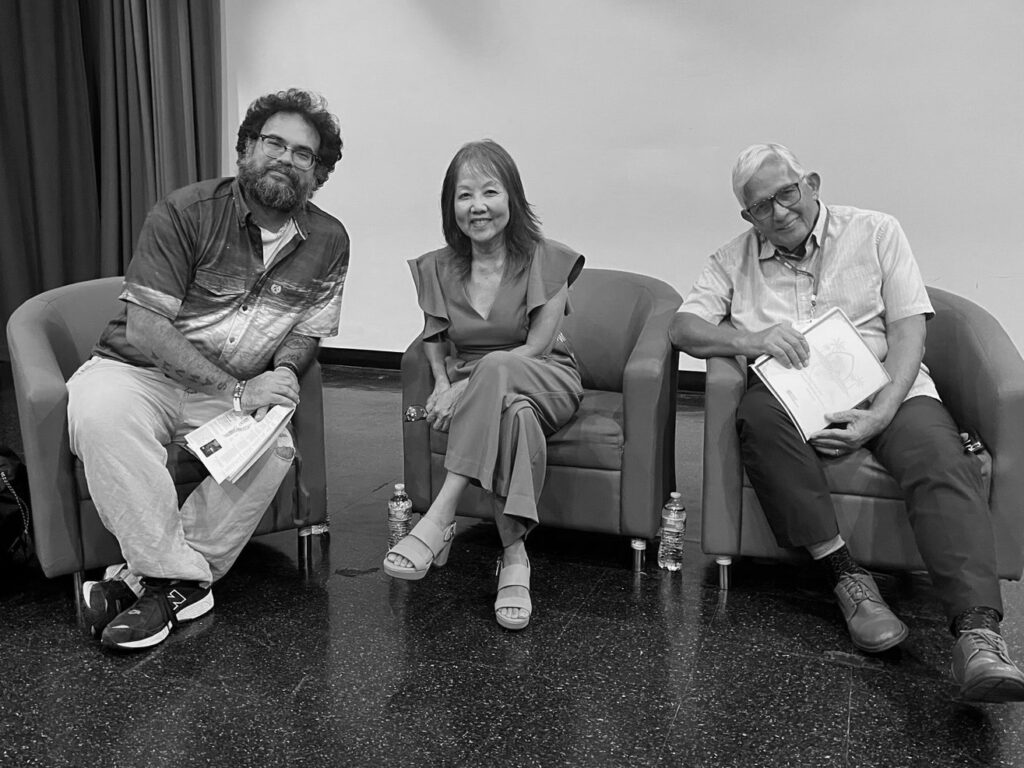
Association for Asian American Studies Annual Conference – Boston, MA (April 23, 2025)
Photo by Antony Wong
According to data from the United Nations High Commissioner for Refugees (UNHCR), in 2025, across Asia and the Pacific, there are 17.2 million refugees, internally displaced persons, and stateless people. People from Asia, and in particular Southeast Asia, represent the largest refugee group ever to resettle in the U.S. Despite this, refugee studies is still underrepresented within Asian American studies. This is particularly true for works that expose the connection between war and displacement in the region, and that center refugee concerns, perspectives, knowledge production, and global imaginings.
For the first two decades of my academic career, I did not write—or more accurately, I did not know how to write—about the Vietnam War or about Việt refugees. As I shared in a 2005 essay in Amerasia Journal on the 30th anniversary of the end of the Vietnam War, it was the U.S. war in Iraq that (re)turned my attention to the war in Việt Nam: the brutal displacement of thousands of Iraqi men, women, and children clarified for me the intimate connections between war violence and refugee displacement. In Body Counts: The Vietnam War and Militarized Refuge(es), published in 2014, I argue that the refugee figure constitutes a site of social and political critiques, making visible the violence of war and displacement, what I term “militarized refuge(es).” I also note that the resettlement of Vietnamese refugees, facilitated by the passage of the Refugee Act of 1980, and their (expected) display of gratitude have enabled the United States to recast its war in Việt Nam, which killed up to 3 million Việt soldiers and civilians, as a necessary and even benevolent intervention.
On the 50th anniversary of the resettlement of Việt refugees, and the 45th anniversary of the passage of The Refugee Act of 1980, it is important to assess how U.S. refugee policies and practices of refuge have changed in the intervening years. During the Cold War, the admission of refugees fleeing communist countries, with Việt refugees as the paradigmatic case, served as a potent symbol to demonstrate the alleged superiority of a democratic United States over communist regimes. With the end of the Cold War in 1991 leaving America as the world’s sole superpower, the U.S. removed the propaganda value of admitting refugees from former communist countries. This produced a political environment that has grown increasingly hostile to the resettlement of refugees, even those who have been displaced by U.S. military actions. The emergence of the War on Terror (2001-2021), the globalized campaign against “terrorism” that displaced as many as 59 million people, spawned xenophobia and Islamophobia. It has cast these refugees as threats to be excluded and eradicated, rather than victims to be rescued and resettled. As Eric Tang argues, “Today’s refugees are construed as an entirely unique racial problem that reflects the public’s anxieties over national security and is managed by practices such as racial profiling, surveillance, and detention rather than humanitarian resettlement” (p. 176).
Removing Refuge
During the 2016 presidential campaign, Republican candidate Donald Trump called for the United States to bar all Muslims from entering the country until further notice, while rival Ben Carson likened Syrian refugees to “a rabid dog running around your neighborhood.” The first Trump administration drastically reduced the number of refugees that could enter the United States. Between 2017-2020, the U.S. resettled only 118,202 refugees—the fewest in any four-year period since the creation of the 1980 Refugee Act, and the first time in modern history that the country has resettled fewer refugees than the rest of the world.
According to the UNHCR, and the American Immigration Council, the number of forcibly displaced people around the world has skyrocketed over the past decade, growing from 42.7 million at the end of 2012, to 122.6 million as of June 2024, marking the twelfth consecutive annual increase. During this same period, refugee resettlement to the U.S. has been paused, access to asylum at the U.S.-Mexico border has been halted, and expedited removal processes have expanded. In January 2025, at the start of his second administration, President Trump signed an executive order indefinitely suspending the U.S. Refugee Admissions Program (USRAP); and the Departments of State, Homeland Security, and Health & Human Services suspended all processing and refugee-related funding. The following month, February 2025, marked the only month since the 1980 Refugee Act’s passage that the U.S. did not welcome a single newcomer refugee.
As one of the 110,000 South Vietnamese refugees part of Operation New Life airlifted out of Việt Nam in April 1975, I feel a strong responsibility to call out and condemn both the U.S. military operations that drive displacement worldwide and the U.S. refusal to offer refuge to these displaced peoples. According to Idean Salehyan, a statistical analysis of refugee resettlement from 1990-2019 reveals that the U.S. prioritization of refugees from its military conflicts abroad declined considerably with the wars in Iraq and Afghanistan. As the U.S. continues to significantly cut its refugee admissions, my stance has moved from a critique of Operation New Life as a nationalist project deployed to recuperate American international standing as a moral and benevolent nation, to a demand that Operation New Life be available to populations forced to flee their homes due to U.S. armed conflict in their countries.
Changing Landscapes of War and Asylum
The U.S. war in Afghanistan and post-war treatment of Afghan evacuees exemplifies the changing landscape of asylum and refugee admissions. In 2001, following the September 11 attacks, the United States unleashed a military campaign in Afghanistan to dismantle al-Qaeda and remove the Taliban government that harbored them. This has resulted in the deaths of at least 176,000 Afghans. With the collapse of the Afghan government in August 2021, two decades after U.S.-led forces toppled the Taliban regime in what became America’s longest war, Afghans already comprise the largest protracted refugee population in Asia, and the second largest refugee population in the world.
Following the Taliban’s takeover of Afghanistan in August 2021, the U.S. launched Operation Allies Welcome, facilitating the evacuation and resettlement of approximately 200,000 Afghans who had worked with or on behalf of the U.S. government. However, unlike the Việt evacuees who were offered permanent residency, Afghan nationals arriving under Operation Allies Welcome were granted humanitarian parole but no pathway to achieve Green Card status, leaving them in legal limbo. The suspension of USRAP by President Trump’s January 2025 executive order, cancelled travel for Afghans who already had flights booked. In June 2025, the administration revoked Temporary Protected Status (TPS) for Afghan nationals residing in the U.S., and blocked U.S. citizens and green card holders from sponsoring Afghan relatives’ visas with the latest travel ban. The collective result of these policies has left a countless number of Afghans separated from family, stuck in Afghanistan, or stranded in countries that might evict them.
Sutured Kinships
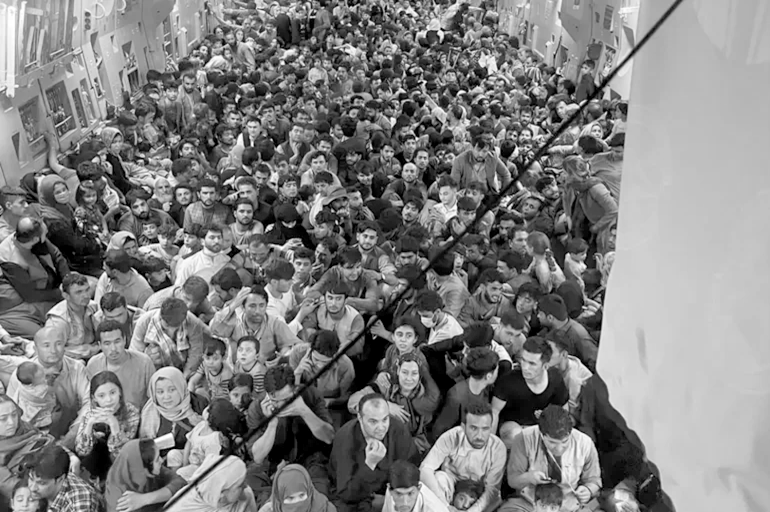
in flight from Kabul (August 17, 2021) © Aljazeera
The 2021 Aljazeera photo of over 600 Afghan men, women and children crouching and cramming against each other on the floor of an American military plane leaving for Kabul, with thousands more Afghans surging to the airport and some swarming the taxiing planes in desperate attempts to flee, brought me and many Vietnamese back to our own chaotic evacuation in 1975. Indeed, the last time the U.S. evacuated such a large number of fleeing refugees was five decades ago, during the last stage of the Vietnam War. As thousands of Afghans still in Afghanistan face an uncertain future under Taliban rule, Vietnamese Americans—many of whom are children of refugees—have urged U.S. officials to take responsibility and resettle as many Afghan refugees as possible. For example, Georgia State Rep. Bee Nguyen has called on political leaders to increase the cap on Afghan refugees: “The reality is in Vietnam and Afghanistan, the United States played role in what happened and part of our responsibility is to acknowledge that role and to open up our country to the people who have been impacted by it.”
Vietnamese refugees and their children have also volunteered and raised funds to help with Afghan refugee resettlement efforts . Here I offer the term “sutured kinship”—horizontal connections that develop to tend to the wounds caused by imperial and military violence among incommensurable yet linked groups—to describe the practices of care that resettled Vietnamese offered to displaced Afghans and others, to stanch the latter’s “wound” while they rebuild their lives. Just as sutures are removed or automatically dissolved once the wound has healed, I argue that the practice of “sutured kinship” does not need to persist past the emergency period for it to be effective or noteworthy.
Gratitude
While writing this essay for CUNY FORUM, I was in Guam to take part in the 50th Commemoration and Reunion of Operation New Life. The highlight of this four-day gathering (July 24 to 27, 2025), including a panel talk at the Guam Museum Theater, was the genuine hospitality extended to the Việt refugee returnees by the local Chamorros. In Body Counts, I connect the militarism that has displaced Vietnamese people to the militarized colonialism that continues to dispossess Chamorro peoples, calling for the possibility of an antimilitarist association of these two distinct but linked groups. In April 1975, U.S. federal authorities selected Guam to serve as a processing hub for Việt refugees without input from local leadership. The Pacific Command representative estimated that the island of Guam could shelter a maximum of 13,000 people for a short duration. However, in all, more than 115,000 refugees passed through the island, far exceeding Guam’s own civilian population at that time by at least 25,000, and overwhelming the islands’ limited resources.
Returning to Guam fifty years later, I was able to meet and personally thank some of the many Chamorro people that played a crucial role in Operation New Life, to welcome and process Vietnamese refugees on their beautiful island. Two particular events moved me deeply. The first was a visit to the Guam Veterans Cemetery, the resting place of some Việt refugees who passed during Operation New Life, including a one-month-old infant. In a genuine and generous gesture of care, the local Chamorros had been tending to these graves—cleaning headstones, weeding, trimming grass, and ensuring the overall upkeep of the burial plot—on behalf of the Việt family members who had left the island.

Photo by Max Ronquillo
The second event was an invitation from the Barrigada community leaders to visit their community center, located near the center of the island. We were warmly welcomed into the center with a wondrous song and dance performed by the young community members, and told that this was how we should have been welcomed to Guam fifty years ago when we first landed as refugees. This warm welcome of the once-displaced Việt people extended by the local Chamorro people contrasts sharply with the violent xenophobia toward refugees and immigrants displayed by the current U.S. government.
In 1975, most Việt refugees spent only two or three weeks on Guam before being transported to the United States. The fact that our brief stay continues to resonate with the local people spawns hope for building further connections between our two peoples. Writing on Asian-Indigenous relationalities, Malissa Phung suggests that expressions of refugee indebtedness can and should take the form of acknowledgement, respect and gratitude towards Indigenous communities for welcoming them on their colonized lands, and to turn these sentiments of thanks into actionable projects that signify solidarity with Indigenous people’s goal of decolonization.
This essay is not an academic analysis, but a collection of refugee stories, my refugee stories, that mix personal reflection with historical recollection, and revel in survival and beauty. In Departures: An Introduction to Critical Refugee Studies, written jointly by the Critical Refugee Studies Collective, we emphasize the power of stories—as a creative force to connect, empower, and transform. Accordingly, I conclude here by elevating storytelling as a social justice practice, exhorting us to flood the world with refugee stories that energize and humanize, because as writer Dina Nayeri says, “our stories [are] drumming with power.” On the 50th anniversary of the “end” of the war in Việt Nam, our refugee stories continue to decolonize, expose and critique, but also shield, elevate and restore. Born from war but also from beauty, and told on the run, our refugee stories weave together the many stories and people we encounter along our journey that lift and hold us. To the Chamorro people, Si Yu’os ma’åse’. May our lives continue to cross again and again.
Further Readings
Aljazeera, “Over 600 Afghans Cram into US Cargo Plane in Flight from Kabul,” 17 August 2021. https://www.aljazeera.com/news/2021/8/17/over-600-afghans-cram-into-us-cargo-plane-in-flight-from-kabul
Yến Lê Espiritu, Body Counts: The Vietnam War and Militarized Refuge(es) (Oakland, CA: University of California Press, 2014).
Yến Lê Espiritu, “Loss and Found: Sutured Kinship in the Aftermath of War and Displacement,” English Language Notes 63:1 (April 2025): 11-26.
Yến Lê Espiritu, Lan Duong, Ma Vang, Victor Bascara, Khatharya Um, Lila Sharif, and Nigel Hatton, Departures: An Introduction to Critical Refugee Studies (Oakland, CA: University of California Press, 2022).
Idean Salehyan, “Strategic Humanitarianism and US Refugee Admissions after the Cold War,” International Studies Quarterly 69:3 (June 2025).
Deepa Shivaram, “Children of Vietnamese Refugees Feel Empathy, Responsibility to Help Afghans,” National Public Radio (NPR), 22 August, 2021. https://www.npr.org/2021/08/22/1029771169/vietnamese-refugees-afghans-kabul-saigon-help
Eric Tang, Unsettled: Cambodian Refugees in the New York City Hyperghetto (Philadelphia: Temple University Press, 2015).
