© Forever Spring
AS A STORYTELLER, I’VE COME TO UNDERSTAND that compelling narratives rarely unfold all at once. Instead, they emerge piece by piece—through individual memories, artifacts, and personal connections. This reflective essay outlines the development of my documentary Forever Spring (Trường Xuân), which explores Vietnamese refugee history and intergenerational trauma through a hybrid of community storytelling, archival research, and scientific inquiry.
Grassroots Approaches
In 2019 while working as an archival researcher on the PBS docuseries Asian Americans, I noticed a troubling scarcity of online archival material related to Southeast Asian communities. Digital documentation and preservation of visual imagery from these communities were minimal. Recognizing this gap, I proposed to the producers that I take a more grassroots approach by engaging directly with Vietnamese community centers instead of relying solely on digital sources.
That summer, I traveled to Northern California and visited the Việt Museum (Museum of the Boat People & the Republic of Việt Nam) in San José. There, I met the museum director, Mr. Vũ Văn Lộc. While showing me the museum’s collection, one particular exhibit caught my attention: a customized model ship placed inside an empty fish tank, suspended by a sculpted tidal wave, and pulled by a miniature tugboat. Intrigued, I asked Mr. Vu about it.
The Trường Xuân Refugees
He recounted the story of the Trường Xuân, a cargo vessel originally used to transport scrap metal. In late April 1975, during the final days of the Việt Nam War, as American forces withdrew and fear of persecution by incoming communist forces escalated, thousands of South Vietnamese sought escape. The Trường Xuân was abandoned by its owner and lacked both a full crew and functional equipment. Yet Captain Phạm Ngọc Luy, who had recently returned from overseas, took command, assembled a makeshift crew, and departed from the Sài Gòn River on April 30, 1975.
The journey was perilous. Nearly 4,000 people were crammed aboard the malfunctioning ship. It got stuck on the riverbed, faced gunfire from communist forces, and barely reached international waters. When the engine failed and the ship began taking on water, Captain Luy sent out an SOS. On May 2, 1975, the Danish cargo ship Clara Maersk rescued all aboard and brought them to Hong Kong, making them the first wave of Vietnamese “boat people.”
I recorded Mr. Vu’s account, which included stories of loss and birth on board. A year later, during the COVID-19 lockdown, I edited that footage into a short video and shared it online. Unexpectedly, I received a message from Howard Jones, a former British Royal Air Force helicopter crewman, asking about the baby born on the Trường Xuân. He had helped transport the newborn and her mother to a military hospital in Hong Kong on May 4, 1975.
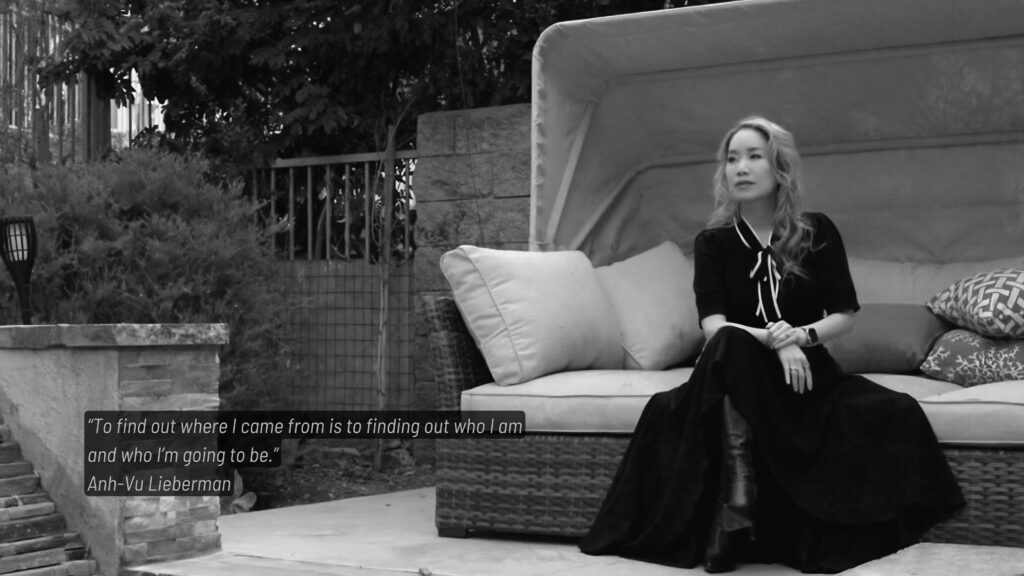
Compelled by Mr. Jones’ request to help find the “Trường Xuân baby,” I located her after several days. Her name was Anh Vu Lieberman. We spoke by phone, and I arranged a virtual reunion between her and Mr. Jones on her 45th birthday, May 2, 2020. Though this was the first time in my career I met subjects through a screen rather than in person, the conversation was heartfelt. Anh shared her life story, including childhood trauma and abuse from her mentally ill father.
That encounter stayed with me. Anh’s story felt powerful, and I decided to pursue it as my next documentary. Despite numerous funding rejections, I persisted, sensing the historical and emotional depth of this narrative—marking fifty years since the end of the Việt Nam War and the start of the Vietnamese diaspora. Still, I questioned: What is the film’s central message? What have we learned in fifty years of displacement?
War, Exile, Loss
In my previous work, I have often explored trauma—of war, of exile, of loss. Yet I began to wonder about its ripple effects: How does trauma affect those with no direct memory of the events? I encountered young Vietnamese Americans born in the United States who struggled with fragmented family histories and the silence of their parents’ generation. Much like the Issei in Japanese American history, the first generation of Vietnamese immigrants often internalized pain, prioritizing survival and dignity instead. Their children, meanwhile sought healing without knowing the source of their wounds.

© Forever Spring
Determined to broaden the narrative, I looked for other perspectives. One day I found a social media post from Kristyana Pham, who wrote about the Clara Maersk and her search for identity. She had recently discovered that her mother was pregnant with her during the Trường Xuân journey. She was born weeks later in a Hong Kong refugee camp, but her parents had never disclosed the perilous escape.
Cross-Generational Trauma

Kristyana described lifelong mental health struggles and noted that therapy helped her trace them back to prenatal trauma. Her story underscored a vital insight: scientific grounding could enhance the film’s impact. To contextualize these stories within scientific discourse, I sought insights from maternal mental health research. I ultimately connected with Dr. Catherine Monk of Columbia University, a leading figure in perinatal developmental science. Initially reluctant to participate, she agreed after learning about Anh and Kristyana. Her inclusion added an empirical framework to the film’s exploration of transgenerational trauma. I also interviewed Dr. Suzie Xuyen Dong, a Vietnamese American clinical psychologist in Los Angeles, to highlight culturally relevant mental health approaches.
Forever Spring became a documentary not only about refugee history, but also how trauma echoes across generations. It interrogates: How is trauma transmitted within families? How can communities confront inherited pain with cultural sensitivity? How might healing begin?
Though “intergenerational trauma” has become a recognized term today, the mechanisms—historical, psychological, biological—through which trauma is passed remain underexplored in popular discourse. This project seeks to bridge that gap. The film offers a trauma-informed approach that emphasizes understanding what happened to a person over pathologizing what is “wrong” with them. It advocates for safe storytelling spaces and empathetic community engagement.
Forever Spring was not conceived for traditional media distribution through film festivals or streaming platforms. Instead, it emerged as a catalyst for collective healing within Asian American communities. At its core, Forever Spring is envisioned as a metaphorical campfire—a safe, inclusive space where individuals can connect, share stories, and feel free from the weight of stigma. To bring this vision to life, we developed the Forever Spring Impact Campaign to illuminate persistent disparities in mental health care, particularly within Southeast Asian American populations.
These disparities are deeply rooted in a complex matrix of cultural stigma, historical trauma, and limited mental health literacy. Together, these factors create formidable barriers to accessing care and engaging in open dialogue. The campaign’s mission is to elevate these concerns into the public consciousness by fostering community-centered conversations, breaking down stigma, and promoting a greater understanding of the unique mental health challenges faced by many Vietnamese Americans.
Recognizing the emotional and transformative power of storytelling, the campaign collaborates with local social service agencies, healthcare providers, grassroots organizations, and cultural institutions. Together, we are organizing a series of community-based events—including film screenings, webinars, and facilitated panel discussions—in cities with significant Vietnamese American populations across the U.S. Additionally, to encourage intergenerational engagement, the campaign incorporates Parents Are Human, a bilingual card game designed to spark meaningful conversations between children and their parents.
The campaign specifically targets younger Vietnamese Americans who are actively seeking to understand the historical and emotional context of their inherited trauma. Many of these individuals are second-generation, born after the Việt Nam War and without a direct connection to its historical events. In this effort, we have partnered with the Rose Bridge Project, a student-led organization in Orange County, California whose mission is to empower students and families by increasing access to culturally relevant mental health education, resources, and peer support networks. The Project envisions a compassionate community in which mental wellness is prioritized, stigma is challenged, and individuals are equipped with the tools needed to thrive.
Our collaboration formally launched at the opening event of the Forever Spring Impact Campaign, at Rose Café in Orange County on September 6, 2025. Through this campaign, we aim to create safe and judgment-free spaces where individuals can begin—or continue—conversations about mental health with their loved ones. Our broader objective is to support those who have suffered in silence, encourage them to seek help, and ultimately contribute to the development of stronger, more resilient communities.
In retrospect, the development of Forever Spring was shaped by both isolation and unexpected connection. The 2020 global pandemic offered the stillness necessary for long-silenced stories to surface. From a museum exhibit to an online video project and then to conversations with strangers across time zones, the project evolved as a patchwork of narrative fragments, forming a shared and complex memory. What began as a search for archival materials gradually transformed into a meditation on rediscovery, resilience, and the enduring need for intergenerational connection.

Healing through Forever Spring
Now, more than fifty years after the Fall of Sài Gòn, the trauma of war remains unresolved for many in the Vietnamese diaspora. While mainstream American narratives have often framed the Việt Nam War as a national loss, and the Vietnamese state continues to promote a victorious David-versus-Goliath account, the personal and communal aftermath remains largely unexamined. The postwar experiences of displacement, resettlement, and silence have been buried beneath the broader refugee resilience stories.
A recent personal physical injury taught me that even after a wound appears to have healed, rehabilitation is necessary to rebuild strength and restore function. This insight is applicable to our communities: trauma left unspoken or unprocessed continues to fester. Language barriers, cultural expectations, and communication gaps exacerbate intergenerational divides, and these unresolved tensions perpetuate cycles of trauma. As Toni Morrison has powerfully stated, the essence of trauma lies in “the pain and suffering of others, the unwillingness to witness or acknowledge, and to pass on to future generations what has been left unresolved.”
Through Forever Spring, we seek to witness, to hear, and to begin the collective work of healing.
Due to the defunding of the Corporation for Public Broadcasting—a taxpayer-funded agency that supported all of Đức’s documentaries—his completed works are available for public viewing on his YouTube channel, Right Here in My Pocket (youtube.com/righthereinmypocket), until the end of 2025.
URL: foreverspring.online
