

© Vietnam Full Disclosure
“Children, everybody, here’s what to do during war. In a time of destruction, create something.
A poem. A parade. A community. A school. A vow. A moral principle. One peaceful moment.”
– Maxine Hong Kingston, The Fifth Book of Peace
Fifty Years after the War
In April 1975 when the Việt Nam War ended and I came home, I thought, after all our nation had been through, that we had learned our lessons and would never do all that again. I thought that an era of peace was at hand. Racial and social equality would continue to improve. We would address our social problems, and the country would have a bright future. I could not have been more wrong.
As of this writing on July 7, 2025, it has been fifty years since the end of the American War on Việt Nam. Much has changed, but sadly, our country’s blood lust for war has not. Today, we support with arms Israel’s genocide of Palestinians in Gaza. In June 2025, the U.S. bombed Iran’s nuclear facilities in support of Israel’s unprovoked and illegal attack on that country. We pushed NATO up to the very boundaries of Russia, withdrew from our nuclear agreements with Russia, and engineered a coup in Ukraine, thus ultimately provoking Russia’s February 2022 full-scale invasion and war with Ukraine. U.S. officials have called China an “existential threat” and surrounded it with 60% of our naval forces, built up military bases, and developed new agreements and military preparations with our “allies” (some would say “vassal states”) for war on China.
This is in addition to the coups and “Color Revolutions” we have funded and directed against Global South nations around the world, and our bombing and invading of foreign nations for much of the last fifty years. With over 750 military bases in at least eighty foreign countries, we dominate the world with a military budget larger than the next nine nations combined. It is with great sadness, grief, and anger that I look out on the death and destruction my country has caused in nation after nation. The Việt Nam War-era experiences that I describe in my interview with the Courage to Resist podcast pale in comparison to the death and suffering the United States has caused millions of ordinary people on every continent on Earth.
Nuclear war is being talked about in high places in the U.S. and abroad, and active preparations are being made. How did we get to this state?
A Timeline of U.S. Empire
In the years since the American War in Việt Nam, events have tumbled down like great houses of cards falling out of an endless deck. The U.S. has pivoted away from peace and back toward the constant exercise of global power. The timeline that follows attempts to impose a necessary order on this chaotic and overwhelming fifty-plus year sequence of history.
|
Year |
Events |
|---|---|
|
February 21-28, 1972 |
U.S. president Richard Nixon goes to China, even before the end of the Việt Nam War, and China opens to the world. |
|
1979 |
China hasn’t fought a war since the 1979 one-month border dispute with Việt Nam, which was resolved peacefully. Prior to that, China’s last major war was the Korean War (1950-1953)—a twenty-six year gap. Compare that to the U.S. record of continuous military involvement and wars over the last seventy-five years. |
|
1992 |
The U.S.S.R. fell, the Cold War ended, and Francis Fukuyama wrote the book, The End of History and the Last Man. Gleeful but naive Washington elites rallied around strategies like the “Wolfowitz Doctrine” and the “Project for a New American Century” (founded in 1997), which projected a future in which America would be the dominant “superpower” shaping and ruling the world, and acting to prevent any future power from rising to challenge U.S. hegemony the way the Soviet Union had. |
|
1999 |
In Europe after the fall of the U.S.S.R., the U.S. absorbed former Warsaw Pact nations one by one into NATO, isolating Russia and withdrawing from nuclear and missile agreements that had prevented the Cold War from turning hot. |
|
October 7, 2001 (Afghanistan) |
The U.S. has attacked multiple competitors one by one. In the Middle East, we attacked a series of countries: Afghanistan, Iraq, Libya, and Syria, all with strong central governments capable of standing up to us—and effectively broke Libya and Syria. We have isolated Iran while our ally Israel has constantly built new settlements and cleared out Palestinians, and is currently committing a genocide of Palestinians in Gaza. |
|
2011 |
Starting with U.S. president Barack Obama’s “Asian Pivot,” the U.S. moved 60% of its naval power to Asia, threatened North Korea with regime change through multiple administrations, supported hawkish right-wing forces in Japan, revived military base agreements with the Philippines, moved THAAD (Terminal High Altitude Area Defense) anti-missile batteries into South Korea, and organized the Quad and AUKUS. All these actions are focused on enhancing military capabilities against China. NATO is joining the U.S. in gunboat diplomacy off China’s coast, just as the same European nations did in the Colonial Period. |
|
2014 |
The U.S. supported a right-wing coup in Ukraine to overthrow a pro-Russian democratically-elected government to install an American proxy, and pushed NATO up against the very borders of Russia, provoking a Russian invasion and a major war in Europe. |
|
2018 |
U.S. officials, including Senator Tom Cotton, former CIA Deputy Director Michael Ellis, former U.S. trade chief Robert Lighthizer, and others, have declared China an “existential threat” to the United States. Former Secretary of State Hillary Clinton famously said, as a private citizen, “I don’t want my grandchildren to live in a world dominated by the Chinese.” |
|
2018-2022 |
The FBI’s “China Initiative,” disbanded under the Biden administration, racially profiled Chinese American scientists, leading to the prosecutions of 162 individuals, almost all proven innocent in the end, according to the APA Justice Task Force. Today there is talk of reviving it. In 2020, South Korean Army veteran and Asian American scholar, K.J. Noh, wrote an expose of the U.S. global strategy (counterpunch.org/2020/10/16/the-us-is-set-on-a-path-to-war-with-china-what-is-to-be-done). |
|
2020-2021 |
The demonizing of China inspires hate crimes against Asian Americans. This spiked during the Covid-19 pandemic when U.S. president Donald Trump called the disease the “Chinese virus” and “Kung Flu,” setting off a wave of 10,905 anti-Asian hate incidents including murders, according to statistics by Stop AAPI Hate. |
|
Ongoing |
The U.S. has surrounded China with military bases. Both the Republican and Democratic parties, along with the mainstream media, are busy demonizing China and pushing toward war. Air- China is following its ancient strategy—the same one it has successfully followed for five thousand years: securing its own borders and trading with the rest of the world via the ancient Silk Roads, of which the Belt and Road Initiative (BRI) is simply a modern version of. (https://peacepivot.org/the-china-fear-factor/) Yet the U.S. elite deem this an “existential threat.” |
Coming Home
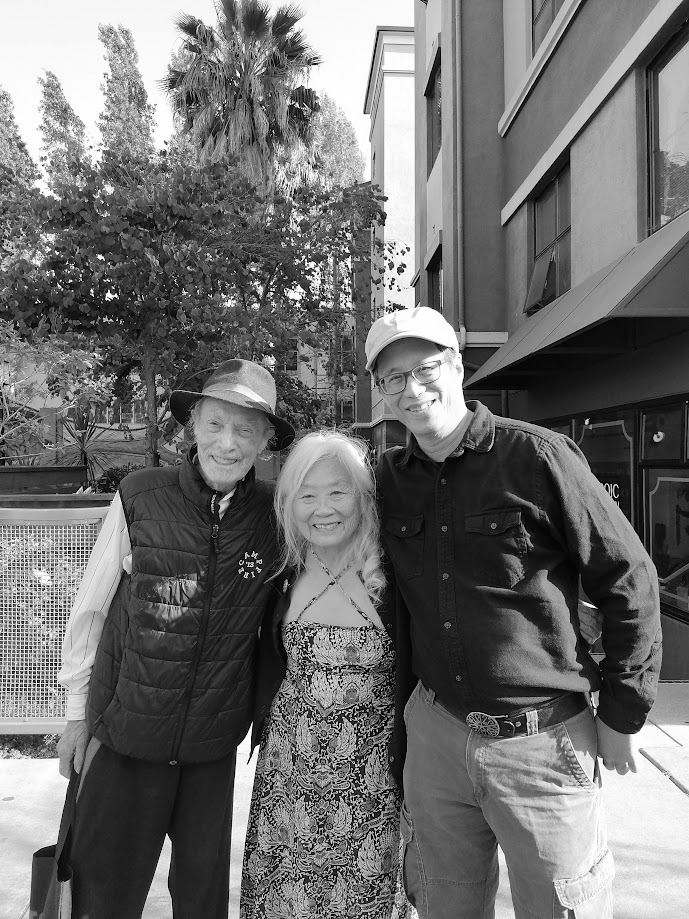
wearing his Army field jacket and combat boots.
I came home after the war to a hero’s welcome by my family and closest friends. I had successfully defied the U.S. Army and our country’s illegal and immoral war in Việt Nam. I had graduated from York University in Canada with a B.A. in Social Science. I had prevailed.
But things weren’t as simple as they first appeared. The country had changed. In San Francisco Chinatown where I grew up, I was shocked to see homeless White people begging in the streets. White people… When I was a child, we Chinese Americans were the poor people, working hard to maintain our homes and get an education. The Whites were above us on the social ladder. Negative stereotypes on TV and the movies had routinely put us down, with White actors in yellowface acting stupidly as fake Asians, and White children taunting us with racial slurs, which we threw back at them. When I deserted the Army and left the country, the Army and the Establishment said we would be disgraced, nobody would ever hire us, and we would be losers living in the gutter.
Now reality seemed suddenly reversed. Poor Whites begged in Chinatown. We war resisters were warmly welcomed home, and people said, “You people were right all along, the war was wrong.” And much later I would hear about the combat veterans being the ones who struggled with PTSD, with some of them becoming homeless. It was good to be accepted, but also disorienting. What country had I returned to? It wasn’t the same country I left. I felt like Rip Van Winkle.
I wandered back and forth between the United States and Canada for almost a decade, unsure of where I wanted to live. Then in 1983, the U.S. invaded Grenada.
I realized the U.S. was going back on the warpath, and if I wanted to have anything to say about it, I had to be here. I also realized that I needed to be here for my parents as they got older. But Canada offered me a saner, safer, better quality of life place to live, including excellent universal health care. I had also started a career in social services, which turned out to be a field I was particularly good at. Canada was a much saner country, and had much better developed services.
But finally, I decided that I had to return to the U.S. Duty to peace and to my family outweighed personal advantage. Nine years after the end of the Việt Nam War, I came home for good.
Entering the Peace Movement
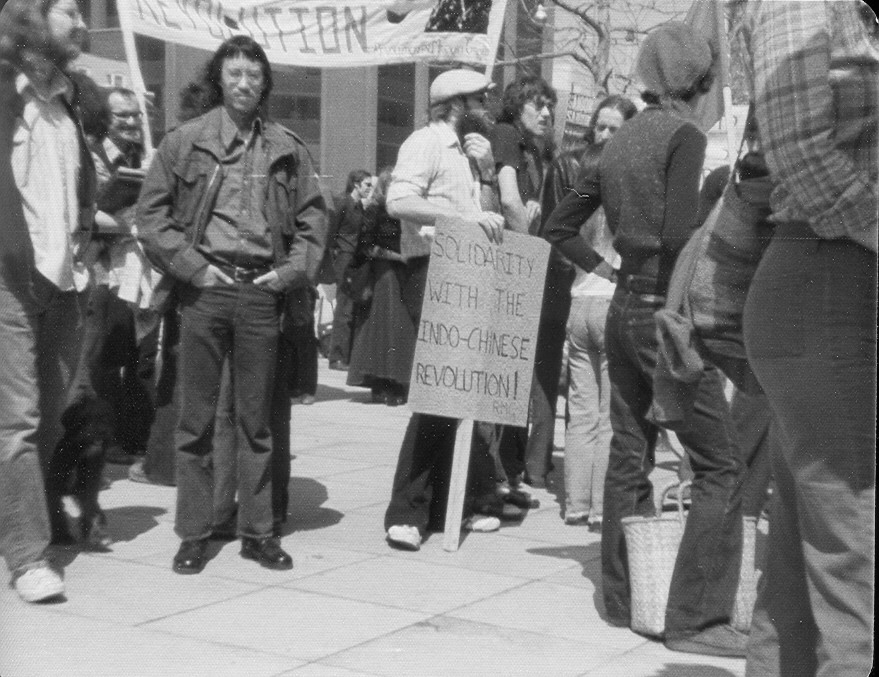
At a 1990 peace demonstration in the run-up to the first Persian Gulf War, a crowd of about a thousand suddenly parted in front of me like the Red Sea, and I saw a small table with four large men standing behind it. The men’s sign said, “Vietnam Veterans Against the War.” Something in me tugged; I knew I had to talk to them. I walked up to the largest man who seemed to be the leader and said, “You guys are Việt Nam veterans?” He answered, “Yes.” I said outright, “I was a U.S. Army deserter during Việt Nam.”
At that moment, I had no idea what kind of reaction I would get. Would they beat me up, or talk to me? The man threw his arms wide open, and yelled, “Brother!” and wrapped me in a giant bear hug. They all welcomed me home with great enthusiasm. That was my introduction to what eventually would become the San Francisco chapter of Veterans For Peace (veteransforpeace.org), a national organization with a few international chapters.
I also returned to university, got a Master of Social Work, and had a successful career as a social worker. Shortly after joining Veterans For Peace, I joined famed Chinese American author Maxine Hong Kingston’s Veterans Writers Group.
During the Iraq War (2003-2011), I was very active in Veterans For Peace, becoming the vice president of the San Francisco chapter, organizing demonstrations, and being one of the local leaders of the campaign to support 1st Lt. Ehren Watada, the first Army officer to publicly refuse orders to Iraq. The campaign also allowed me to become a key link between the Asian and the peace communities.
I was featured in a small part in the documentary Sir! No Sir! (displacedfilms.com/films/sir-no-sir) that came out in 2005, about the GI resistance to the Việt Nam War. I was also featured in the books, A Matter of Conscience: GI Resistance During the Vietnam War (1992) by William Short and Willa Seidenberg, and Waging Peace in Vietnam: U.S. Soldiers and Veterans Who Opposed the War (2009) edited by Ron Carver, David Cortright, and Barbara Doherty, as well as mentioned several times in Maxine Hong Kingston’s book, The Fifth Book of Peace, and published in the anthology she edited, Veterans of War, Veterans of Peace.
After the Iraq War, I joined the “Comfort Women” Justice Coalition (remembercomfortwomen.org) to build a statue in San Francisco to honor the over 400,000 women whom the WWII Japanese Imperial Army all across Asia, forced into brutal sex slavery; a system of violence that 90% of them did not survive. The Japanese Consulate, Prime Minister Shinzo Abe, and Japanese right-wingers spoke and organized against us, but we prevailed and the statue now stands in St. Mary’s Square near Chinatown since 2017.
In 2018, forty-odd members of Veterans For Peace, including myself, attended the fiftieth anniversary of the Mỹ Lai massacre, and met with Vietnamese veterans of the war. I’ve since joined the Veterans For Peace national board, and served a term as the national vice president.
In response to America’s escalating war drive against China, we in the Chinese and peace communities formed Pivot To Peace (peacepivot.org), to advocate for peace and cooperation rather than war with China. Later CODEPINK formed their “China is Not Our Enemy” campaign (codepink.org/china) to also advocate for peace with China.

A Call to Peace
And so, with U.S. wars in Europe, the Middle East, and a drive to war with China, our nation seems poised on the edge of a cliff—that cliff being total world war—WWIII, with multiple nuclear armed states. But there is another alternative.
The Washington elite may be too blind to see this, but we—a mere 4% of the world’s population—don’t need to dominate the 96% of the world, turning a majority of the world against us by attacking one country after another, sanctioning much of the world, and making essentially everybody either our vassal or our enemy. We in the U.S. are a large nation, with good natural resources, an educated workforce, easily defended national borders, and no real enemies other than those that we create ourselves by threatening nations far from our borders, for no reason other than that they are minding their own business and not being our vassal states.
China has thrived for five thousand years by simply securing their own borders and trading with the rest of the world via the ancient Silk Roads. We, a young nation not even three hundred years old, would do well to follow their strategy. We are in a perfect position to do so, because we have similar natural attributes, but with much more easily defended borders—our two oceans to our east and west, and two friendly neighbors to our north and south. We can choose to continue making war on the world, or we can live in relative peace and prosperity for the next five thousand years.
April 30, 2025, was the official day of the fiftieth anniversary of the end of the American War in Việt Nam. Việt Nam held a huge victory parade in Hồ Chí Minh City, formerly Sài Gòn. A Veterans For Peace contingent was honored to have a place in the grandstand. Thousands of troops, Vietnamese and allies including from China, marched proudly as massive crowds of Vietnamese and foreigners cheered. Dancers and musicians followed the troops. From San Francisco as I watched the parade on YouTube, deep and intense feelings flowed through me. Scenes from the past welled up in my mind. So much suffering, for so many. So many people that I met over the years—soldiers from various armies and both sides, veterans suffering and sometimes dying from PTSD, Agent Orange, and other war ills, ordinary civilians—hurt by the war, came back to my memory.
The next day, April 30, 2025, here in San Francisco (the U.S. is one day behind Asia in the time zones), a small group of us from Veterans for Peace held a remembrance outside the War Memorial Veterans Building. We took turns speaking, and a Vietnamese woman who lost both her parents and a brother in the war tearfully spoke about it in public for the first time.
America, it is time to choose peace and life, not empire and death. I have committed my life to advocating for peace and prosperity for all, and neither I nor the world will ever give up, because peace is a fundamental dream of all humanity.
For more info on the topics discussed here by Michael Wong, please read/listen to his April 15, 2019 interview, produced by the podcast, Courage to Resist, in collaboration with the Vietnam Full Disclosure effort of Veterans For Peace, online at vietnamfulldisclosure.org/podcast-mike-wong.
